

A user swaps tokens, borrows against collateral, mints an NFT, or joins a decentralised game, and everything happens through code rather than a bank, broker, or platform employee. That is usually the moment people start asking what is a smart contract and why smart contracts matter so much in crypto. On Ethereum, smart contracts are programs stored at a blockchain address that contain code and state, and they execute when called through transactions.
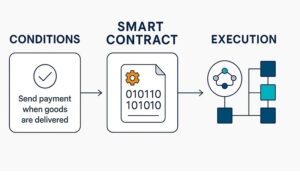
In simple terms, smart contracts are self executing programs on a blockchain. A clear smart contracts definition is this: code that automatically follows predefined rules once the required conditions are met. In blockchain systems, that means logic can run without relying on a central operator to approve each action.
What is a smart contract in simple terms?
The easiest answer to what is a smart contract is that it is a blockchain program that can hold data, enforce rules, and respond to transactions. In Ethereum style systems, a contract has functions and state, and it lives at a specific address on-chain. Solidity documentation describes contracts as collections of code and data that reside at a specific address, while Ethereum documentation describes them as programs made up of data and functions that can execute when they receive a transaction.
That is why smart contracts on blockchain are so important. They replace many manual steps with programmable logic. Instead of trusting a person or company to perform an action later, the rules are written into code and executed according to the contract’s design.
Smart contracts definition and why the term matters
A practical smart contracts definition should be more useful than a slogan. Smart contracts are not magic and they are not legal contracts by default. They are software systems that automate actions according to code. The reason the term matters is that these programs can manage assets, permissions, voting logic, marketplaces, loans, and many other blockchain activities.
This is also where the phrase what are smart contracts in crypto becomes important. In crypto, smart contracts are often the engine behind decentralised applications. They are the rule layer that decides what happens when a wallet interacts with a protocol.
How smart contracts work

The clearest way to explain smart contracts is to break the process into steps.
1. A developer writes the contract
In Ethereum based systems, many developers use Solidity for smart contract development. Solidity documentation describes it as a high level language for implementing smart contracts that target the Ethereum Virtual Machine.
2. The contract is deployed on-chain
Once deployed, the contract gets its own blockchain address. From that point, users or other contracts can interact with it. Ethereum documentation describes deployment as publishing executable code into the network state so that anyone can request execution through a transaction.
3. Users call functions
A wallet or another contract sends a transaction that triggers a contract function. That function may transfer tokens, update internal records, check balances, issue an NFT, or run other programmed logic. Solidity documentation notes that a contract’s functions must be called for anything to happen.
4. The blockchain records the result
Once the transaction is confirmed, the new state becomes part of the blockchain record. That is one reason blockchain smart contracts are often described as transparent and deterministic. The code runs according to its rules, and the state changes are recorded on-chain.
What are smart contracts in crypto used for?
The phrase what are smart contracts in crypto usually leads to one practical question: what do they actually do? The answer is a lot. Crypto smart contract systems are used for:
- decentralised exchanges
- lending and borrowing protocols
- stablecoin systems
- NFT minting and marketplaces
- on-chain games
- governance and voting
- automated payments
- token issuance and vesting
Because smart contracts on blockchain can enforce rules automatically, they are the core building blocks of many decentralised applications. Ethereum describes smart contracts as the foundation of its application layer.
Smart contract cryptocurrency and the role of tokens
The phrase smart contract cryptocurrency usually refers to blockchain ecosystems where programmable contracts are a core feature. In practice, this includes networks that support decentralised applications, token logic, and contract based execution.
A crypto smart contract does not have to create a new coin, but it often controls token behaviour. Many tokens exist because a contract defines supply, transfers, permissions, or issuance rules. That is why blockchain smart contracts are so closely tied to the wider token economy.
Smart contracts on blockchain vs traditional systems
The main difference is who enforces the rules. In a traditional system, a company database and internal staff may control updates, approvals, and records. With smart contracts on blockchain, the rules are enforced by the blockchain network through code execution. That does not make every outcome automatically fair or safe, but it does change the trust model. Users rely more on code and network validation, and less on a central operator.
This is one reason smart contracts are so attractive in finance, digital ownership, and decentralised infrastructure. They reduce the need for manual approval in environments where predictable execution matters.
The limits of smart contracts
Smart contracts are powerful, but they are not unlimited. First, they only know what the blockchain knows. If a contract needs outside information such as a market price, a weather result, or a sports score, it usually needs an oracle or another trusted data input. Oracle documentation explains that blockchain applications use oracle networks to connect smart contracts with external data and systems.
Second, smart contracts only follow code. They do not understand fairness, intent, or context beyond what developers write. If the code is flawed, the contract may still execute exactly as written.
Smart contract development and why security matters
Smart contract development is not just about writing working code. It is also about writing safe code. Once a contract is deployed, changes can be difficult or impossible depending on the design. Ethereum’s security guidance notes that smart contracts can control large amounts of value and data, which makes vulnerabilities attractive targets for attackers.
That is why smart contract development usually includes:
- clear logic design
- code review
- automated testing
- security checks
- deployment planning
- monitoring after launch
Ethereum documentation also describes smart contract testing as the process of checking that contract code works as expected and satisfies reliability, usability, and security requirements.
Common risks of crypto smart contract systems

A balanced explanation of smart contracts should include the main risks.
Coding errors
A bug in a crypto smart contract can affect funds, permissions, or system behaviour.
Irreversible execution
If a contract executes a harmful transaction, reversing it may be difficult.
Oracle dependency
If a contract depends on external data, the quality of that data matters.
Poor upgrade design
Some projects need upgrades, but upgradeable systems also introduce governance and trust questions.
Complex interactions
A contract may be safe on its own but risky when combined with other protocols, tokens, or external calls.
These risks do not make blockchain smart contracts unusable. They mean the design and review process matters just as much as the feature list.
Why smart contracts matter beyond crypto speculation
Many people first encounter smart contracts through tokens and trading, but their importance is wider than that. Smart contracts make it possible to automate financial logic, ownership records, application rules, and multi party interactions in a transparent way.
That is why what is a smart contract is more than a beginner question. It is really a question about how digital systems can enforce rules without relying on one company or intermediary for every action.
Final thoughts
For readers asking what are smart contracts in crypto, the key point is simple: they are the logic layer behind many decentralised applications, tokens, and on-chain services. Smart contract development makes those systems possible, but it also requires careful testing, security review, and realistic expectations about limits and risk.
FAQ
What is a smart contract?
A smart contract is a program stored on a blockchain that executes predefined rules when triggered by a transaction.
What is the smart contracts definition in simple terms?
A practical smart contracts definition is automated blockchain code that holds data and carries out actions according to predefined conditions.
What is smart contract development?
Smart contract development is the process of designing, writing, testing, deploying, and maintaining smart contracts for blockchain applications. Solidity is one of the main languages used for this in Ethereum style environments.
How do smart contracts on blockchain get outside data?
Smart contracts on blockchain usually need oracle systems or similar mechanisms when they must use data from outside the blockchain.
Are blockchain smart contracts always safe?
No. Blockchain smart contracts can contain bugs, design flaws, oracle risks, or upgrade risks, which is why testing and security review are essential.
Disclaimer: The material in this article is not financial or investment advice. Everything stated here reflects the author's personal view and should not be treated as a recommendation to trade or invest. We make no warranties regarding the accuracy, reliability or completeness of the information presented. Cryptocurrency markets are highly volatile and can move unpredictably. Before committing any funds, every investor, trader or crypto user should study several independent sources and check the regulations that apply in their own jurisdiction.