
Choosing between an S&P 500 ETF and an S&P 500 mutual fund can seem tricky at first. Both options give investors access to the same broad slice of the American stock market. Both can hold many of the same companies. Both are often used by beginners and experienced investors alike. Yet the structure behind each product can affect costs, convenience, trading flexibility, tax efficiency, and the overall investing experience.
That is why the debate around ETF vs mutual fund remains so popular. On the surface, they may look almost identical, especially when both track the S&P 500. In practice, however, the differences can matter quite a lot depending on how you invest, how often you contribute, and what you expect from your portfolio.
In this guide, we will break down the mutual fund vs ETF question in a simple way. We will explain how each investment vehicle works, where the similarities lie, and what investors should consider before choosing an ETF or mutual fund for long term exposure to the S&P 500.
What Is the S&P 500?
The S&P 500 is a stock market index made up of 500 of the largest publicly traded companies in the United States. It is widely seen as one of the best benchmarks for the overall US equity market. When investors buy a fund that tracks the S&P 500, they gain exposure to major sectors such as technology, healthcare, finance, consumer goods, industrials, and energy.
Rather than trying to pick winning shares one by one, an S&P 500 fund allows you to buy a diversified basket of large companies in one product. This is one reason the ETF vs mutual funds discussion often begins with index investing. For many people, both formats offer an accessible route into the market with broad diversification and relatively low costs.
What Is an ETF vs Mutual Fund?
A common question from new investors is what is an ETF vs mutual fund. The short answer is that both are pooled investment vehicles. They collect money from many investors and use that capital to buy a portfolio of assets. In this case, those assets are the shares of companies in the S&P 500.
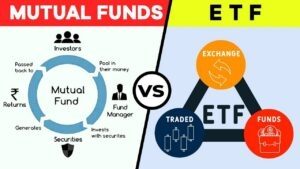
The key difference is in how they are bought, sold, priced, and managed. An ETF, or exchange traded fund, trades on a stock exchange throughout the day, much like an ordinary share. Its price changes as the market moves, and investors can buy or sell it whenever the exchange is open.
A mutual fund, by contrast, is usually bought directly from a fund provider or through an investment platform. It does not trade continuously during the day. Instead, all buy and sell orders are processed at the fund’s net asset value, usually calculated once after the market closes.
So when people ask what is the difference between mutual funds and ETFs, this trading mechanism is one of the first and most important distinctions.
How S&P 500 ETFs Work
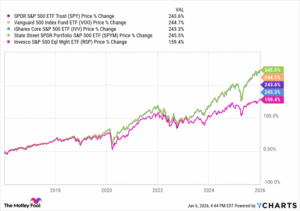
An S&P 500 ETF is designed to track the performance of the index as closely as possible. The fund holds the same companies, generally in the same proportions as the index itself. Because it trades on an exchange, investors can place market orders, limit orders, and in some cases even use more advanced trading strategies.
For long term investors, that flexibility may not always be necessary, but it is still a defining feature in the ETF versus mutual fund comparison. ETFs are often praised for their transparency, low annual fees, and tax efficiency. Many investors also like the ability to buy them through a standard brokerage account just as easily as buying shares in a company.
Another advantage is that ETFs can often be purchased with no minimum investment beyond the price of one share, or even less if the broker offers fractional investing. That makes them appealing to newer investors who want to start small.
How S&P 500 Mutual Funds Work
An S&P 500 mutual fund also aims to mirror the performance of the index. In many cases, it will hold virtually the same companies as an ETF equivalent. The main difference lies in the investor experience.
With a mutual fund, you do not watch the price fluctuate during the day. You simply place your order, and it is executed at the next available net asset value. This can suit investors who prefer a more hands off approach and do not care about intraday price movements.
Mutual funds are also commonly used in workplace pensions and retirement accounts. Some investors appreciate their simplicity, especially for automatic monthly contributions. Rather than buying a whole number of shares, you can usually invest a precise cash amount, which makes regular investing very straightforward.
This is where the mutual fund vs ETF decision becomes more personal. One structure may not be universally better than the other. It often depends on the investor’s habits and account type.
ETF vs Mutual Fund: Key Similarities
Before focusing on the differences, it is important to note what these products share. In the case of S&P 500 trackers, the similarities are substantial.
- Both give you exposure to a broad basket of leading US companies.
- Both can be passively managed and designed to track the same index.
- Both can be low cost compared with actively managed funds.
- Both may distribute dividends or reinvest them, depending on the share class or fund type.
- Both can play a central role in a long term portfolio.
Because of this overlap, the ETF vs mutual fund debate is not about choosing between a good product and a bad one. It is often about choosing between two efficient structures that serve slightly different needs.
ETF vs Mutual Fund Compared: The Main Differences
Let us look more closely at the areas where exchange traded funds vs mutual funds differ most.
Trading and Pricing
This is perhaps the clearest distinction. ETFs trade throughout the day on the stock exchange, while mutual funds are priced once daily.
If you want real time trading, an ETF usually wins. If you prefer to invest without thinking about intraday price swings, a mutual fund may feel simpler.
In the ETF vs mutual funds debate, this difference matters most for investors who value flexibility or those who want to automate contributions without worrying about market timing.
Minimum Investment
Many mutual funds historically required a minimum initial investment, which could be several hundred or even several thousand pounds or dollars depending on the provider. ETFs generally only require enough money to buy one share, and sometimes even less through fractional shares.
That said, some modern platforms have made mutual funds more accessible, so the gap is not always as wide as it once was. Still, when choosing an ETF or mutual fund, minimum investment rules are worth checking.
Fees and Expenses
S&P 500 ETFs and mutual funds can both be very low cost, especially if they are passively managed. However, ETFs often have a reputation for particularly lean expense ratios.
Mutual funds may sometimes carry higher annual charges, and in certain cases there may be additional fees depending on the platform or share class. Investors comparing ETFs or mutual funds should always look beyond the headline and review the total cost of ownership, including dealing fees, platform fees, and any account charges.
Tax Efficiency
In some jurisdictions, ETFs can be more tax efficient than mutual funds because of the way shares are created and redeemed. This may reduce capital gains distributions to investors.
Tax treatment varies by country and account type, so investors should consider local rules before drawing conclusions. Still, tax efficiency is one reason the ETF versus mutual fund question often leans in favour of ETFs for taxable brokerage accounts.
Automatic Investing
Mutual funds have traditionally been strong in this area. It is often very easy to set up recurring investments for a fixed amount each month. Since mutual funds can usually accept exact cash amounts, they fit neatly into disciplined saving plans.
ETFs can also be used for regular investing, especially on modern platforms, but the experience depends on the broker. Some support automated ETF purchases and fractional shares, while others do not. So in the mutual fund vs ETF conversation, mutual funds may still have a small edge for investors who prioritise automation and simplicity.
Liquidity and Execution
ETFs are generally highly liquid, especially popular S&P 500 funds with large daily trading volume. You can buy or sell quickly during market hours. Mutual funds, on the other hand, are redeemed through the fund company at the end of the day.
For a patient long term investor, this difference may not matter much. But for those who care about immediate execution, the ETF vs mutual fund choice may tilt towards ETFs.
S&P 500 ETF vs Mutual Fund: Which Is Better for Beginners?
Beginners often assume there must be one right answer in the ETF vs mutual fund debate. In reality, both can be excellent starting points.
An ETF may be better for beginners who:
- want low costs
- use a brokerage account
- like the flexibility of trading during the day
- are comfortable placing buy orders themselves
A mutual fund may be better for beginners who:
- want to automate investments easily
- prefer a simple buy and hold process
- invest through a retirement scheme or managed platform
- do not care about intraday prices
The most important point is not whether you choose an ETF or mutual fund, but whether you begin investing consistently and keep your costs low over time. For many people, sticking with a sensible S&P 500 fund matters more than obsessing over the exact structure.
ETF vs Mutual Fund for Long Term Investors
For long term investors, both vehicles can help build wealth steadily over many years. If two funds track the same index and both have low fees, the performance difference may be fairly small over time. Still, small differences in cost, tax treatment, and investing behaviour can add up.
This is why the ETF vs mutual funds comparison should not be reduced to a technical discussion. Investor psychology matters too. Some people trade ETFs too often simply because they can. That flexibility can become a disadvantage if it encourages emotional decisions.
Mutual funds, by offering only end of day pricing, can reduce the temptation to react to every market move. In that sense, a mutual fund may support better habits for certain investors.
On the other hand, disciplined investors who want the lowest costs and strong tax efficiency may prefer an ETF. The better choice is often the one that makes it easier for you to stay invested through market ups and downs.
Exchange Traded Funds vs Mutual Funds: Practical Examples
Imagine two investors who both want to track the S&P 500 for the next 20 years.
The first uses a brokerage app, wants full control, and occasionally adds extra money when markets dip. For this person, an ETF may be more convenient. They can buy throughout the day and keep costs low.
The second invests monthly through a pension or regular savings plan. They want the process to happen automatically and rarely check their account. For this person, a mutual fund may feel more natural.
This example shows why exchange traded funds vs mutual funds is not only a question of product design. It is also a question of behaviour, platform features, and personal preference.
Common Misunderstandings About ETF vs Mutual Fund
One misconception is that ETFs are always cheaper. Often they are, but not always. Some S&P 500 mutual funds are extremely competitive.
Another is that mutual funds are always actively managed. That is not true. Many mutual funds simply track an index. Some investors also assume ETFs are only for traders. In fact, plenty of long term investors use ETFs as core portfolio holdings.
When asking what is the difference between mutual funds and ETFs, it is useful to remember that the underlying investment strategy and the legal structure are not the same thing. A passive S&P 500 ETF and a passive S&P 500 mutual fund may own almost identical portfolios, even though the way you buy them differs.
Final Thoughts on Mutual Fund vs ETF
The S&P 500 remains one of the most popular routes to broad market exposure, and both ETFs and mutual funds can provide it effectively. For many investors, the debate around mutual fund vs ETF is less about returns and more about structure, convenience, and investing style.
If you value flexibility, exchange trading, and often lower costs, an ETF may be the better fit. If you prefer simple automation, end of day pricing, and a hands off experience, a mutual fund may be more suitable.
In other words, the answer to ETF vs mutual fund is not universal. The stronger choice depends on how you invest, where you invest, and which option helps you stay consistent over the long run.
FAQ
ETF vs mutual fund: which is cheaper?
Often, ETFs have slightly lower ongoing fees, but not always. Some S&P 500 mutual funds are also very low cost. The real comparison should include expense ratios, platform charges, and any dealing fees.
Mutual fund vs ETF: which is better for long term investing?
Both can work well for long term investing. The better option depends on your habits. If you want flexibility and low costs, an ETF may suit you better. If you prefer automatic investing and a simpler experience, a mutual fund may be the stronger choice.
Exchange traded funds vs mutual funds: do they hold different assets?
Not necessarily. An S&P 500 ETF and an S&P 500 mutual fund may hold almost the same portfolio. The main distinction is the structure of the fund rather than the underlying assets.
ETFs or mutual funds: which is more tax efficient?
In some cases, ETFs are more tax efficient, especially in taxable accounts. However, tax rules vary by country and by account type, so investors should check the rules that apply to them.
ETFs vs mutual fund: which is easier to buy regularly?
Mutual funds are often easier for automatic monthly investing because you can usually invest a fixed cash amount. ETFs can also work well for regular investing, especially if your platform supports fractional shares and automated purchases.