
The cryptocurrency industry has generated a new set of metrics for understanding the status of the performance of protocols self-explanatorily. Among them is the TVL. If you have ever delved into DeFi platforms, lending apps, staking services, and decentralized exchanges for some time, you must have frequently seen this term. However, the newbie questions remain unceasingly hovering over what is TVL in crypto?
To start with, TVL in simple description is the total value of assets tokenized in a protocol. Actually, it does not mean as such. Total locked value is the most common way to track the liquidity and activity in a DeFi platform. Whenever a user lends his tokens, stakes coins, or puts his liquidity into a pool, he is contributing towards the total value locked for that protocol. This is why the TVL in crypto is known as a quick indicator and a rough gauge of how much capital the project is able to attract and how much trust the users are placing in it.
This guide explains what is TVL, the TVL meaning in crypto, how the metric is calculated, where it is useful, and where it can be misleading.
TVL Meaning in Crypto
Let us start with the definition. TVL means total value locked. In crypto, that usually refers to the combined dollar value of assets deposited into a DeFi protocol, blockchain ecosystem, or decentralised application. These assets can include coins, tokens, stablecoins, liquidity provider tokens, or other forms of on chain collateral.
So when someone asks about the TVL meaning, they are asking how much capital is currently locked inside a protocol’s smart contracts. If a lending platform holds deposited ETH, USDC, and other assets from its users, the current market value of all of those assets together forms that protocol’s TVL crypto figure.
This is why total value locked crypto is often discussed as a sign of adoption. A higher number may suggest that more users are committing funds to the platform, that the protocol has deeper liquidity, or that it is seen as useful within the DeFi ecosystem.
What Is TVL Used For?
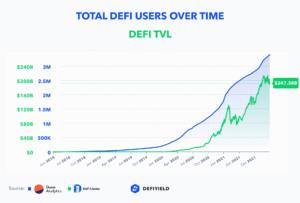
The reason TVL matters is that it gives a snapshot of how much value is actively being used in a protocol. In DeFi, activity often depends on users depositing funds into smart contracts. A decentralised exchange needs liquidity. A lending protocol needs collateral and deposits. A staking platform needs locked assets. Because of that, total value locked has become one of the core metrics for comparing platforms and networks.
Investors and researchers use TVL in crypto for several reasons:
- To estimate the size of a DeFi protocol
- To compare one platform with another
- To gauge liquidity depth
- To track growth or decline over time
- To understand where capital is flowing in the market
A protocol with rising TVL may be attracting more users or more deposits. A falling figure can suggest withdrawals, declining interest, weaker token prices, or a combination of all three. That is why what is TVL in crypto is not just a beginner’s question. It is central to how many people analyse decentralised finance.
Total Value Locked Formula
The basic total value locked formula is quite simple. To calculate a protocol’s TVL, you take each asset deposited into its smart contracts, multiply the amount of that asset by its current market price, and then add all the values together.
In a simplified form, the total value locked formula looks like this:
TVL = sum of all locked asset amounts × current market price of each asset
For example, imagine a protocol holds:
- 500 ETH
- 1,000,000 USDC
- 200,000 of another token
To calculate total value locked, you convert each of those holdings into a common unit, usually US dollars, and then add them together. If ETH rises in price, the protocol’s TVL can rise even if no new users deposit funds. If token prices fall, TVL crypto may decline even if the same number of assets remains locked.
This is one reason why TVL meaning in crypto should always be understood in context. The number reflects both actual deposits and current market valuations.
A Simple Example of TVL
Suppose a DeFi protocol has $5 million worth of ETH, $3 million worth of stablecoins, and $2 million worth of other tokens deposited across its contracts. Its total value locked would be $10 million.
Now imagine crypto prices rise sharply while users do nothing. The ETH and other token deposits may now be worth more in dollar terms. Even without any fresh capital entering the protocol, the TVL might climb from $10 million to $13 million or more.
On the other hand, if prices fall, the platform’s TVL in crypto can decline even when user balances stay the same. This shows why what is TVL should not be interpreted too narrowly. It is a useful metric, but it is partly driven by token price volatility as well as by user behaviour.
Why High TVL Can Matter
A higher TVL is often seen as positive because it may indicate stronger user trust, deeper liquidity, and broader participation. In a decentralised exchange, more liquidity can make trading smoother and reduce slippage. In a lending protocol, larger deposits may support more borrowing activity. In a staking system, a high total value locked crypto figure can signal strong user engagement.
There is also a psychological effect. Platforms with larger TVL crypto numbers often attract more attention because they appear established and widely used. Developers, traders, and investors tend to monitor where capital is concentrated.
That said, high TVL is not a guarantee of quality, safety, or long term success. It is an important metric, but it is not a complete one.
The Limits of TVL
Although TVL means something useful, it is not perfect. One of the biggest issues is that the metric is not fully standardised across all protocols and aggregators. Research from the Bank for International Settlements found that TVL calculations often rely on inconsistent methods and self reported practices, which can make some published figures difficult to verify independently.
There are several reasons why total value locked can be misleading if viewed on its own.
Price changes can distort the picture
A protocol’s TVL can rise simply because token prices increase. That does not always mean adoption has improved.
Double counting may occur
In some cases, assets can be reused across DeFi protocols in ways that make the broader ecosystem look larger than it really is.
Incentives can inflate deposits
Temporary rewards can attract capital that leaves as soon as incentives disappear. A spike in TVL in crypto may therefore reflect short term farming behaviour rather than genuine loyalty.
It does not measure profitability
A platform can have high total value locked crypto and still generate weak revenue or poor user retention.
This is why experienced users do not rely on TVL alone. They also look at revenue, users, tokenomics, security, liquidity quality, and protocol design.
TVL and Market Capitalisation

A common comparison in DeFi is TVL versus market capitalisation. The idea is to compare the value of a protocol’s token with the amount of capital actually locked in its ecosystem. Some analysts use this relationship to judge whether a project looks overvalued or undervalued.
For example, if a token has a very high market cap but only modest total value locked, some investors may see that as a warning sign. If the protocol supports a large TVL relative to its token valuation, others may interpret that differently. Still, this comparison has limits, because market cap and TVL meaning in crypto reflect different things. One measures token valuation, while the other measures deposited capital.
TVL by Protocol and by Chain
You can measure TVL at different levels. Most often, people look at the total value locked of a single DeFi protocol, such as a decentralised exchange or a lending market. But the metric can also be applied to an entire blockchain ecosystem. In that case, it refers to the value of all assets locked across DeFi applications on that chain.
This makes TVL crypto useful for comparing different ecosystems. If one blockchain hosts far more capital in DeFi than another, that may suggest stronger activity, more mature infrastructure, or greater investor confidence. Again, it is only one piece of the puzzle, but it is a widely watched one.
Is TVL Still Important?
Yes, but it should be used carefully. What is TVL in crypto is still a highly relevant question because the metric remains one of the easiest ways to understand DeFi scale at a glance. It is especially helpful for beginners who want a simple indicator of where users are depositing capital.
At the same time, the industry is becoming more aware of the metric’s weaknesses. As DeFi matures, more analysts are combining TVL with other indicators rather than treating it as the single best measure of protocol health. That is probably the right approach. TVL is valuable, but it works best when interpreted alongside broader context.
Final Thoughts
So, what is TVL? In crypto, it is the total dollar value of assets deposited into a DeFi protocol, application, or blockchain ecosystem. The TVL meaning is straightforward, but its interpretation requires more care. TVL means capital committed to smart contracts, often through staking, lending, or liquidity provision. The total value locked formula is simple, yet the number it produces can rise or fall for different reasons, including token prices, new deposits, or changes in user confidence.
For that reason, TVL in crypto is best seen as a useful starting point rather than a final verdict. It can help investors compare protocols, understand liquidity, and track where capital is moving. But it should always be paired with other metrics before making serious decisions.
If you have ever wondered what is TVL in crypto, the short answer is this: it is one of the clearest ways to see how much value a DeFi protocol is currently holding, but not one of the only ways to judge whether that protocol is truly strong.
FAQ
What does TVL mean?
TVL means total value locked. It is a metric used to show how much capital is deposited in a protocol or DeFi ecosystem.
How do you calculate total value locked?
The total value locked formula is based on adding together the current market value of all assets deposited in the protocol. Each asset amount is multiplied by its current price, then summed.
Is higher TVL always better?
Not always. A high total value locked crypto figure can signal adoption and liquidity, but it can also be influenced by rising token prices, temporary incentives, or inconsistent calculation methods.