
Decentralized finance has put in the hands of common users an opportunity to become liquidity providers. And many DeFi protocols use liquidity pools instead of market makers seeking users who provide pairs of assets and are compensated in trading fees in return. The idea stands as simple on paper, i.e., tokens are added to a pool; fees are collected; and the protocol takes care of the rest.
Reality paints a different picture. A major concern for liquidity providers is the impermanent loss that is experienced. Every prospective investor should understand it before depositing funds into any automated market maker, as this risk may reduce or, in the worst-case situation, immediately wipe out any income earned through fees. The AMM makes this via its mechanism to rebalance token reserves, not through an attack or some bug. In fact, for anyone asking what is impermanent loss, the answer starts with understanding how AMMs automatically rebalance assets inside a pool.
This guide explains how the impermanent loss formula works, and what traders and investors can do to reduce the risk. This is also where impermanent loss explained in simple terms becomes important for new liquidity providers.
What Is Impermanent Loss?
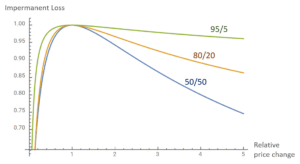
Impermanent loss is the difference between the value of assets held inside a liquidity pool and the value of those same assets if they had simply been kept in a wallet. It occurs when the relative price of the two deposited tokens changes after the deposit is made. As the AMM adjusts the ratio of assets in the pool, the liquidity provider ends up holding less of the asset that has risen more strongly and more of the asset that has performed worse. This is why liquidity pool impermanent loss is such a widely discussed risk in DeFi.
In other words, impermanent loss is not about your position falling in absolute terms only. You can still make money overall. The issue is that your position may perform worse than a basic buy and hold strategy. This is the core of impermanent loss crypto and why it matters to anyone providing assets to AMM protocols.
This is why the topic matters so much in DeFi. A pool can appear profitable because it generates trading fees, yet once you compare your final withdrawal value with the value of simply holding the same tokens, the result may be disappointing.
Why Is It Called Impermanent?
The term can be slightly misleading. The loss is called impermanent because it only becomes locked in when you withdraw your funds while the price ratio remains changed. If prices later return to the same relationship they had when you first deposited, the gap can shrink or disappear.
However, in real markets, prices do not always move back to their starting ratio. Many liquidity providers exit during periods of volatility, which means the so called impermanent loss becomes a real loss at the moment of withdrawal. So while the label suggests something temporary, the outcome is often permanent in practice. That is why impermanent loss explained properly should always include the distinction between unrealized and realized loss.
How Impermanent Loss Happens
Imagine you deposit ETH and a stablecoin into a 50-50 liquidity pool. At the time of deposit, both sides have equal value. In return, you receive a share of the pool.
Now suppose ETH rises sharply in the broader market. Because AMMs are designed to keep the pool balanced according to a formula, traders will buy the cheaper ETH from the pool until the pool price aligns with the external market price. This process changes the composition of the reserves. The pool ends up holding less ETH and more of the stablecoin. The liquidity provider still owns the same share of the pool, but not the same number of tokens originally deposited. The constant product logic used by many AMMs is what drives this rebalancing.
When the provider withdraws, they receive fewer ETH and more stablecoins than they started with. If ETH has appreciated strongly, the total value of that withdrawal may be lower than the value of simply holding the original deposit outside the pool. That difference is impermanent loss. In many DeFi discussions, this exact effect is referred to as impermanent loss liquidity pool risk.
The same principle applies in reverse when one asset falls significantly. The provider gradually accumulates more of the weaker asset and less of the stronger one.
Why Impermanent Loss Matters for Liquidity Providers
For many newcomers, liquidity provision looks like a passive income strategy. The protocol shows an attractive annual percentage yield, and trading fees appear to provide a steady stream of returns. Yet those numbers do not tell the whole story.
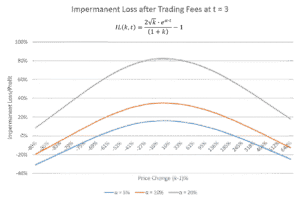
Impermanent loss can quietly reduce the net performance of a position. In low volatility pools, the effect may be minor and easily offset by fees. In more volatile pools, especially those involving speculative assets, the difference can be substantial. A position can generate respectable fees and still underperform a simple hold strategy. This is why impermanent loss crypto is one of the first concepts every DeFi investor should learn.
This is why liquidity providers should think in terms of net return rather than headline yield. The real question is not how much the pool pays, but whether those rewards are enough to compensate for the price divergence between the assets in the pair.
Impermanent Loss Formula
For a standard 50 50 AMM pool, the impermanent loss formula is commonly expressed as:
IL = 2 × √r / (1 + r) – 1
In this formula, r is the price ratio change between the two assets. If one token doubles relative to the other, then r = 2. The result is usually shown as a negative percentage, reflecting how much worse the liquidity pool position performs compared with holding the assets. The source article notes that the effect is non linear, so larger price moves create disproportionately larger losses. Many users combine this formula with an impermanent loss calculator to estimate outcomes before entering a pool.
Here are a few common reference points for a 50 50 pool:
- 1.25x price change gives a small loss
- 1.5x price change leads to roughly 2 percent loss
- 2x price change leads to roughly 5.7 percent loss
- 3x price change leads to roughly 13.4 percent loss
- 4x price change leads to roughly 20 percent loss
These figures are estimates, but they show the core point clearly. Impermanent loss grows faster than many people expect.
A Simple Example
Assume you deposit £1,000 of ETH and £1,000 of USDC into a pool, for a total position value of £2,000. Later, the price of ETH doubles while USDC remains stable. If you had simply held your original assets, your portfolio would now be worth £3,000.
Inside the pool, however, your ETH exposure would have been reduced as arbitrage traders bought ETH from the pool during the price increase. You would end up with more USDC and less ETH than if you had just held both assets separately. Even though your pool position might still be worth more than £2,000, it would likely be worth less than £3,000. This simple example is often used in guides where what is impermanent loss needs to be shown in practical terms.
The pool may also have generated fees, which can partly offset the difference. Whether the position is still attractive depends on the size of those fees relative to the loss.
Stable Pairs Versus Volatile Pairs
Stablecoin pairs such as USDC and DAI usually experience very little divergence because both assets are designed to remain close to the same value. In these pools, impermanent loss is often minimal. That makes them popular with more cautious liquidity providers. The Changelly article highlights stable pairs as lower risk specifically because their price ratio tends to remain tight.
Volatile pairs are a different story. Pools involving ETH and a smaller altcoin, or two fast moving speculative assets, can produce significant price divergence in a short period of time. In these cases, liquidity pool impermanent loss can become the dominant factor in the outcome of the strategy.
The Link Between Impermanent Loss and Yield Farming
Yield farming often adds extra token rewards on top of normal swap fees. This can make returns look very attractive, especially during strong market sentiment. But yield farming does not remove impermanent loss. It simply adds another source of return that may or may not compensate for it. The source article makes the same point clearly: farming rewards can outpace the loss in some cases, but not always.
This means a liquidity provider should avoid looking at the reward token in isolation. A pool that offers a high annual yield can still be a poor choice if the underlying assets are prone to sharp divergence. Incentives can improve the economics, but they do not change the mechanics of the AMM. That is a key part of impermanent loss explained for anyone attracted by high APR figures.
Key Factors That Affect Impermanent Loss
1. Price volatility
The stronger the price movement between the two assets, the greater the divergence and the greater the impermanent loss. This is the single most important factor.
2. Asset correlation
Pairs that tend to move together usually carry less risk. Stablecoins are the obvious example, but correlated wrapped assets or closely related tokens may also reduce the effect.
3. Pool design
Many traditional AMMs use a simple 50-50 structure, but not all pools are identical. Some protocols use different weightings, while concentrated liquidity models allow providers to allocate capital within a chosen price range. These designs can improve capital efficiency, but they can also increase risk if the market moves outside the expected band. The source article notes that concentrated liquidity can mean higher fee income, but potentially greater downside once price moves out of range.
4. Trading fees and incentives
Fees can offset some or all of the loss in high volume pools. The more active the pool, the better the chance that fee income will compensate for adverse price movement. The same applies to farming incentives, although reward tokens introduce their own risks.
5. Market events
Sudden news, exchange listings, liquidations, or broader market panic can all accelerate price divergence. In such moments, liquidity providers may discover that what looked like a balanced position is far more exposed than expected. This is another reason why impermanent loss liquidity pool dynamics should never be ignored.
Can Impermanent Loss Become Severe?

Yes. In extreme cases, it can be devastating. History has shown that when one side of a liquidity pair collapses, providers can be left with a very large share of the failing asset. The source article uses the UST and LUNA collapse as an example of how a pool cannot protect users when one token rapidly loses most of its value.
This is an important reminder that impermanent loss is not merely a mathematical inconvenience. In unstable or poorly designed ecosystems, it can amplify capital destruction.
How to Reduce Impermanent Loss
There is no universal way to eliminate impermanent loss, but there are several ways to manage it more carefully.
Choose lower volatility pairs
Pairs made up of stablecoins or strongly correlated assets usually experience smaller price divergence. They may offer lower upside, but they often provide more predictable outcomes.
Compare net returns, not advertised yield
Always assess whether expected fees and rewards are likely to exceed the potential impermanent loss. A headline APR means little without context.
Use the impermanent loss formula before entering
The impermanent loss formula can help estimate how sensitive a pool is to different price moves. Even a rough scenario analysis is better than depositing blindly.
Pay attention to market conditions
Entering a pool shortly before a major event, token unlock, or high volatility period can increase risk dramatically. Timing does not remove the problem, but it can influence how much price divergence develops after entry.
Understand the protocol design
Read how the AMM works, how fees are structured, and whether the pool uses concentrated liquidity or another specialised model. Small design details can materially change risk.
Review positions regularly
Liquidity provision is not always a set and forget activity. If price ratios have shifted significantly, it may be worth reassessing whether the pool still fits your strategy.
Final Thoughts
Impermanent loss is one of the central trade offs in DeFi liquidity provision. By adding funds to a pool, you gain access to trading fees and possibly reward tokens, but you also accept the risk that changing prices will leave you worse off than simply holding the same assets in a wallet.
That does not mean liquidity pools should be avoided. It means they should be approached with realistic expectations. In calm, high volume, well structured pools, fee income may make the strategy worthwhile. In volatile pairs, the maths can turn against you very quickly.
Anyone considering DeFi should understand impermanent loss before providing liquidity, not after withdrawing. A basic grasp of AMM mechanics and the impermanent loss formula can make the difference between a sensible allocation and an expensive lesson.
FAQ
What is impermanent loss in simple terms?
Impermanent loss is the gap between the value of assets in a liquidity pool and the value of those same assets if you had simply held them in your wallet. It happens when the relative price of the tokens changes. This is the essence of impermanent loss liquidity pool risk.
How do I calculate it?
You can estimate it using the impermanent loss formula: IL = 2 × √r / (1 + r) – 1, where r is the change in the price ratio between the two assets.
Is impermanent loss the same as losing money?
Not exactly. You can still make an overall profit in a pool. Impermanent loss means your result is worse than it would have been if you had simply held the assets instead.