
If you are looking for the best privacy coins in 2026, you already know that things have changed. A few years ago, most people treated this niche like a list of “coins for anonymous payments.” Today, serious investors and compliance-minded users want something more useful: which projects still deliver meaningful privacy, which ones can adapt to regulation, and which networks actually have the liquidity and developer momentum to matter. That is the lens this guide uses.
Put simply, privacy coins are crypto assets or privacy-focused networks designed to hide some combination of the sender, receiver, amount, wallet balance, smart-contract state, or transaction metadata. If you have ever asked what are privacy coins or what is a privacy coin, the clean answer is this: they are systems that make financial activity harder to surveil by default or by design, while still letting transactions be verified as valid.
That also means not every project in this space works the same way. Some privacy coins crypto users prefer, like Monero, are private at the base-layer payment level. Others, often described as privacy tokens or a privacy token, focus on confidential smart contracts, private DeFi, or privacy add-ons for public chains. In 2026, that distinction matters more than ever.
The State of Financial Privacy in 2026
Why Privacy Matters: Beyond the “Illicit Activity” Myth
The lazy critique is that privacy only exists to hide crime. That misses how normal financial life works. Salaries, treasury moves, supplier payments, trading positions, donations, and consumer purchases all reveal sensitive information when they are fully public onchain. Privacy is not the opposite of lawfulness; it is often the condition for ordinary security. Even Zcash and Secret’s documentation frame privacy as a usability and data-protection feature, not just a cloak.
You even see this in search behavior. People looking for private crypto, privacy cryptocurrency, or the most private cryptocurrency are often not trying to vanish from the law. They are trying to avoid broadcasting their balances, counterparties, or business flows to every blockchain explorer on earth. That is a rational goal, especially for merchants, funds, and high-net-worth holders.
The Great Delisting
The bigger 2026 story is not that privacy disappeared. It is that distribution changed. Regulated exchanges have become more selective, especially in Europe. Kraken’s official support page says it delisted Monero in the EEA due to regulatory changes, halting trading and deposits on October 31, 2024, and later converting remaining balances to BTC after the withdrawal deadline.
That pressure is connected to the EU rulebook. MiCA has applied fully since December 30, 2024, while the EBA’s travel-rule guidance requires CASPs to transmit identifying information and apply procedures around self-hosted-wallet transfers. The newer AMLR goes further by targeting anonymous crypto-asset accounts and accounts allowing increased obfuscation by CASPs, including through “anonymity-enhancing coins.”
So yes, the market for privacy coins cryptocurrency is tighter on centralized venues. But that does not mean privacy tech is dead. It means regulated access increasingly favors assets and protocols that can support selective disclosure, auditability, or clean-funds proofs when needed. That is exactly why Zcash viewing keys and Railgun’s assurance tools matter so much in 2026.
Privacy vs. Anonymity: Understanding the Technical Nuance
One reason this category gets misunderstood is that privacy and anonymity are not identical. A network can obscure transaction contents while still exposing some metadata. It can also protect smart-contract state without making every wallet fully anonymous. Monero leans closest to full transactional privacy by default; Zcash offers selective privacy; Oasis, Secret, and Railgun are more about programmable or application-level confidentiality.
That is why some terms people search, like cryptocurrency privacy coins or even the awkward phrase cryptocurrency security coins, are too broad to be useful by themselves. The real question is not “Is it private?” but “What exactly is private, by default, and under whose threat model?”
Top Privacy Coins for 2026: Security, Tech, and Liquidity
Before the deep dive, here is a practical comparison table. Our “Regulatory Difficulty” rating is an editorial judgment based on default privacy, exchange access pressure, and availability of compliance tools such as viewing keys or selective disclosure.
| Asset | Privacy Tech | Default Privacy | Regulatory Difficulty | Transaction Fee |
| Monero (XMR) | Ring signatures, stealth addresses, RingCT, Bulletproofs+ | Yes | High | Dynamic/variable |
| Zcash (ZEC) | zk-SNARKs, Orchard, Halo, Unified Addresses / Viewing Keys | No | Medium | Usually a fraction of a cent |
| Oasis Network (ROSE) | Confidential EVM, encrypted state, confidential compute | No | Medium-Low | Low-cost; 99%+ lower than Ethereum on Sapphire |
| Secret Network (SCRT) | Encrypted smart contracts, Intel SGX TEEs, private metadata | No | Medium | About 0.005 SCRT average tx example |
| Railgun (RAIL) | zk-SNARK smart contracts, viewing keys, Private Proofs of Innocence | No | Medium | Chain-dependent |
Table notes: Monero’s privacy is mandatory and its fees are dynamic; Zcash describes fees as usually a fraction of a cent; Oasis Sapphire advertises 99%+ lower fees than Ethereum; Secret’s docs give an example average transfer cost of 0.005 SCRT; Railgun fees depend on the chain and gas environment where it is used.
Monero (XMR): The Undisputed King of “Default” Privacy
Monero is a decentralized digital currency that is private by default. Every transaction hides the sender, receiver, and amount using ring signatures, stealth addresses, and RingCT, making routine payments confidential without requiring users to opt into special privacy settings separately.
That private-by-default design is still Monero’s biggest edge. The Monero site says every user is anonymous by default, and its docs emphasize that ring signatures, stealth addresses, and RingCT hide core transaction details on every transfer. In a market full of optional privacy, Monero remains the clearest answer to anyone asking for a true private coin.
From a technical perspective, Monero’s latest major hard fork is still the August 2022 network upgrade, which increased ring size to 16, added Bulletproofs+, introduced view tags, and adjusted fees. In 2025, however, the project’s research agenda stayed active: OSPEAD examined weaknesses in current decoy timing assumptions, while FCMP++ work explored future sender-privacy improvements and outgoing view keys. That makes Monero strong today, but still evolving tomorrow.
Zcash (ZEC): The Pioneer of zk-SNARKs and Shielded Transactions
Zcash remains one of the most important privacy coins because it pioneered mainstream zk-SNARK payments. Its biggest strength in 2026 is flexibility. Shielded transactions are genuinely private, but Zcash also supports unified addresses, viewing keys, and a user experience that can fit more easily into regulated environments than Monero’s all-or-nothing model.
The security story improved materially with NU5, which moved Zcash to the Halo proving system and removed the need for the trusted setup that earlier shielded designs relied on. Since then, the network has continued evolving. NU6.1 activated on November 24, 2025, and the Zcash community continues to discuss and build toward Crosslink, a hybrid PoW/PoS model that could bring staking and economic finality in a future upgrade rather than leaving Zcash frozen in its older architecture.
For investors comparing top privacy coins, Zcash is not the most censorship-resistant option, but it may be the most regulation-adaptable pure privacy coin because it already has a language for selective disclosure. That matters.
Oasis Network (ROSE): The Leader in Programmable Privacy for DeFi
ROSE is not a pure payment-anonymity coin in the Monero mold, but it earns a place on this 2026 privacy coins list because Oasis has become one of the most credible programmable-privacy stacks in crypto. Sapphire is Oasis’s confidential EVM, with confidential state, end-to-end encryption, confidential randomness, 6-second finality, and fees advertised as 99%+ lower than Ethereum.
That makes ROSE a strong choice for users who care less about hiding a simple payment and more about shielding app logic, user data, or DeFi state. If you think privacy’s future is application-layer rather than coin-only, Oasis deserves serious attention.
Secret Network (SCRT): Encrypted Smart Contracts and Private Metadata
Secret Network sits in a similar but distinct category. Its docs describe private data as encrypted at input, state, and output, with Intel SGX-based trusted execution environments handling confidential computation. Secret Contracts can expose public and private metadata in the same application, which is useful for NFTs, onchain identity, and private app logic.
That does not make SCRT the best answer for everyone seeking a classic privacy coin. But it does make Secret one of the more interesting privacy tokens for developers and funds that want privacy-preserving computation, not just hidden transfers. The docs also provide a concrete fee example of about 0.005 SCRT for an average transaction, which is helpful for practical comparison.
Verge (XVG) & Railgun (RAIL): Privacy Layers for Public Chains
Verge still has brand recognition, and it does offer built-in Tor and I2P routing support in its wallet stack. That can help obfuscate IP-level metadata, and the project still markets low fees and quick transactions. But Verge’s privacy is not in the same class as Monero’s confidential amounts or Zcash’s shielded pool. It is best understood as network-obfuscation privacy, not complete onchain confidentiality.
Railgun is the more important 2026 story. It is a zk-SNARK privacy system for Ethereum and other EVM chains, not a legacy standalone payment coin. Railgun lets users privately interact with DeFi while staying on their preferred chain, and it has become especially relevant because it ships compliance tooling: viewing keys, tax exports, and Private Proofs of Innocence that let users prove non-interaction with known malicious sources without exposing their full financial history.
If you are building a modern private crypto shortlist, Railgun belongs above Verge for most serious users in 2026.
How Privacy Coins Work
Ring Signatures and Stealth Addresses
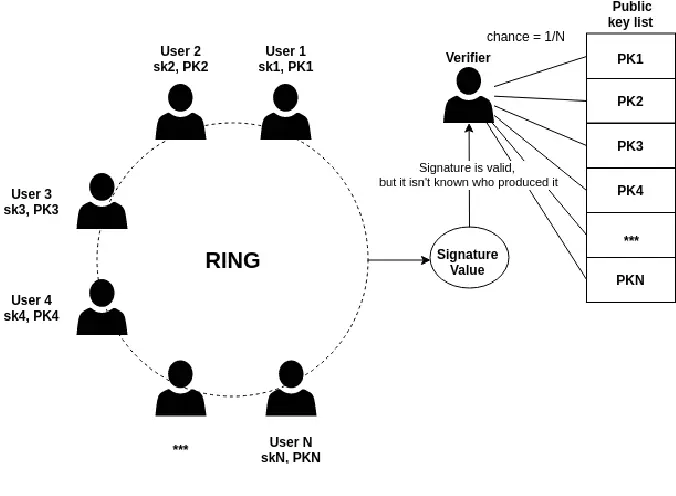
Source: Semanticscholar
Monero’s model combines one-time stealth addresses for recipients with ring signatures and RingCT to blur the real spender and hide the amount. The result is that sender, receiver, and amount are all concealed at the base layer. That is why Monero still sets the standard for default transactional privacy.
Zero-Knowledge Proofs
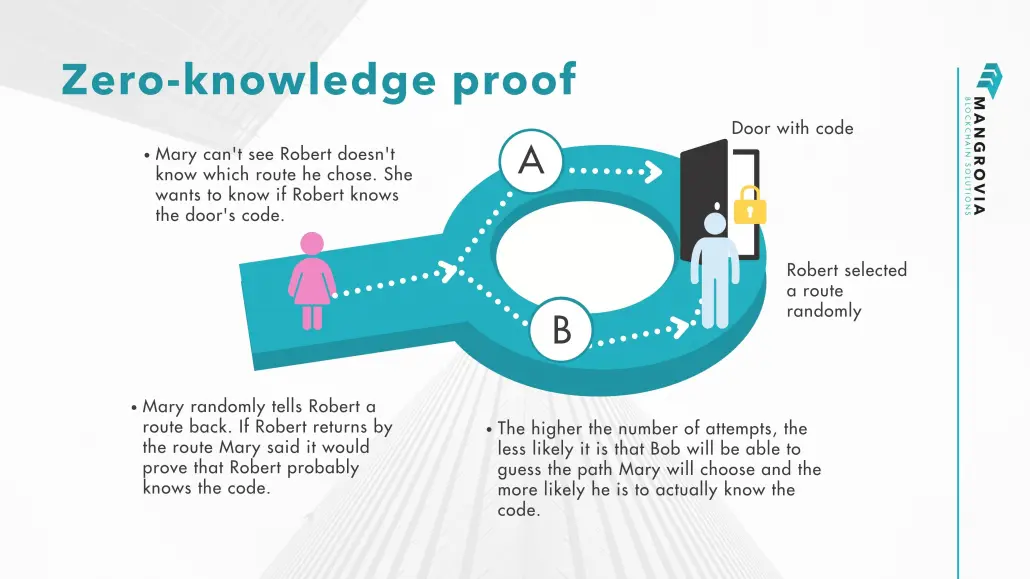
Source: Mangrovia
Zcash and Railgun represent the zero-knowledge branch of this field. A zk-SNARK lets the network verify that a transaction is valid without revealing the underlying sensitive data. Zcash uses this to encrypt shielded payments; Railgun uses it to privatize DeFi interactions on public chains.
Trusted Setup vs. Trustless Systems
This is a real dividing line. Monero’s Bulletproofs and Bulletproofs+ do not require a trusted setup. Zcash originally did rely on trusted setup assumptions for older proving systems, but NU5’s move to Halo removed that dependency for modern shielded transactions. Railgun’s Groth16 circuits do use a trusted setup, while Secret depends more on TEE trust assumptions than pure zero-knowledge cryptography.
Improving Scalability Without Sacrificing Confidentiality
Bulletproofs matter because privacy systems fail if they become too expensive to use. Monero adopted Bulletproofs to shrink proofs and improve verification, and the 2022 upgrade’s Bulletproofs+ made transactions smaller and faster again. In other words, privacy only scales when cryptography gets lighter.
The Regulatory Landscape: Navigating MiCA and AMLR in 2026
The European Travel Rule: Can Privacy Coins Survive?
They can survive technically, but access through regulated intermediaries is harder. The EBA says the travel rule is meant to ensure relevant authorities can trace transfers when necessary, and its draft guidance requires CASPs to gather information on self-hosted addresses, individually identify transfers, and verify wallet ownership above EUR 1,000 using suitable technical means.
That does not kill privacy coins outright. What it does is push the market toward architectures that let users stay private in public while still proving facts to a regulated counterparty when required.
Viewing Keys and Selective Disclosure: The Path to “Compliant Privacy”
This is the most overlooked section in the whole category. Zcash’s viewing-key design exists precisely for situations like auditing, delegated oversight, or legal reporting. ZIP 310 explains what a holder of a Sapling full viewing key can and cannot learn, and ZIP 316 extends the idea to unified viewing keys. That means privacy is not binary; it can be selectively shared.
Monero has a weaker version of this idea through view keys. A Monero view key can reveal incoming transactions to an address, but Monero’s own docs note that outgoing transactions cannot be reliably viewed in the current model, which limits full auditability compared with Zcash. That makes Monero stronger for hard privacy, but weaker for “compliant privacy.”
Railgun pushes this idea even further for DeFi. Its assurance suite includes read-only viewing keys plus Private Proofs of Innocence, which generate zero-knowledge proofs that private funds did not interact with a known malicious set. For professional users, this is one of the clearest bridges between lawful compliance and onchain privacy.
How Users Prove “Clean Funds” Without Doxing Themselves
The broader trend here is bigger than any one coin. Privacy Pools and similar ideas try to solve the compliance problem by letting users prove they are not linked to a bad set, without exposing their whole graph to the public. Railgun’s Private Proofs of Innocence is already a live example of this logic in production.
How to Safely Buy and Exchange Privacy Coins in 2026
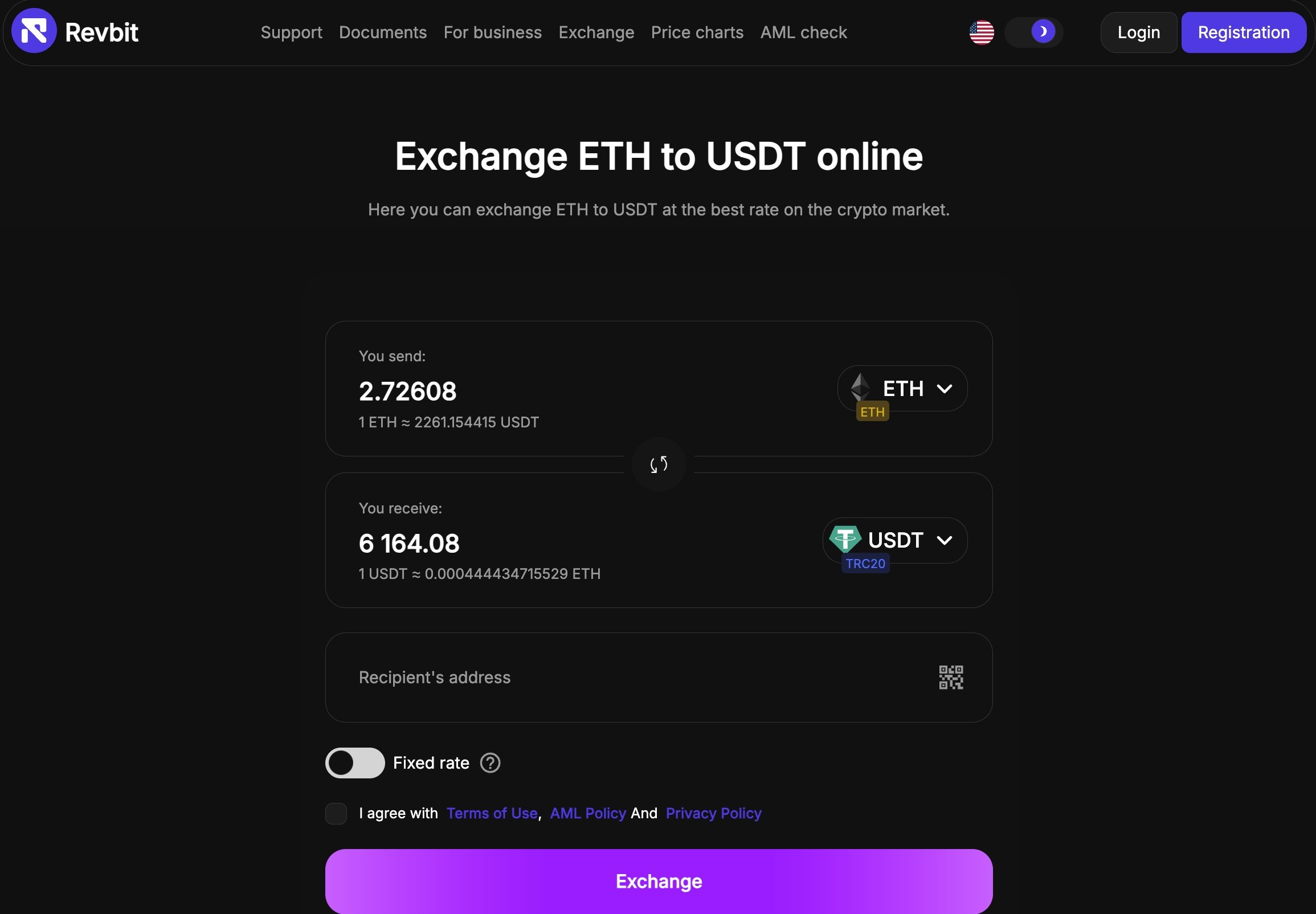
If you use RevBit, use it as an exchange service, not a bank. RevBit is a centralized exchange platform that facilitates instant swaps (like from ETH to USDT) with liquidity partners and it does not hold or manage your funds.
For anyone building a privacy coins list to trade rather than just study, the safer workflow in 2026 is simple: use a self-custody wallet first, confirm network compatibility, and assume regulated off-ramps may ask for more information than the privacy asset itself reveals. Privacy protects your chain data; it does not remove tax or AML responsibilities.
Privacy Coins vs. Privacy Protocols: What’s the Difference?
Layer 1 Privacy (Monero) vs. Layer 2 Privacy (Aztec/Railgun)
Monero is layer-1 privacy: the base asset itself is private. Aztec and Railgun are different. Aztec is now positioning itself as a privacy-first zk-rollup / L2 environment on Ethereum, while Railgun is a privacy system built through smart contracts across existing chains. These systems are less about a single privacy coin and more about privacy infrastructure.
Mixing Services (Tornado Cash) vs. Native Privacy Coins
Native privacy coins build privacy into the protocol. Mixers try to retrofit privacy onto transparent chains. That legal distinction has mattered in practice. The U.S. Treasury sanctioned Tornado Cash in 2022 and then removed those sanctions in March 2025 after reviewing the legal and policy issues, which shows how different the policy treatment can be for mixers versus native privacy architectures.
The Benefits of “Opt-In” Privacy for Institutional Adoption
For institutions, opt-in privacy is often easier to justify than universal opacity. That is why Zcash, Oasis, Secret, and Railgun are getting more serious attention from builders and compliance teams than many older narratives suggest. They can preserve confidentiality where it matters, while still supporting selective disclosure or assurance workflows when law or counterparties require them.
Is Investing in Privacy Coins Viable in 2026?
Yes, but only if you stop thinking of this market as a single bucket. Monero is still the benchmark for hard, default privacy. Zcash is the most mature selective-disclosure privacy coin. Oasis and Secret are better described as programmable confidentiality networks. Railgun is one of the strongest privacy layers for public-chain finance. Verge remains recognizable, but technologically lighter.
So the best answer to “what are the top privacy coins in 2026?” depends on your use case. If you want the hardest privacy baseline, Monero still leads. If you want legally usable selective disclosure, Zcash and Railgun are stronger than most competitors admit. If you think the future belongs to private apps rather than private money alone, ROSE and SCRT deserve a place on any serious privacy coins list.
Critical Questions About Privacy Coins in 2026
Are privacy coins illegal in the United States or EU?
There is no blanket U.S. or EU rule making simple ownership of all privacy coins illegal. In the EU, the practical pressure is on CASPs: MiCA is fully applicable, the travel rule governs information-sharing, and AMLR will prohibit CASPs from providing or custodying anonymous crypto-asset accounts and certain obfuscating account structures, including via anonymity-enhancing coins. In the U.S., the enforcement pattern has focused more on AML obligations and privacy mixers than on a general ban on possessing a privacy asset.
Can Monero transactions be traced by the IRS or FBI?
Not in the easy, Bitcoin-style way. Monero’s design hides sender, receiver, and amount on-chain, so investigators usually need off-chain evidence such as exchange records, seized devices, network metadata, or user mistakes rather than simple public-ledger tracing. That does not make Monero “magic.” It means Monero is best at resisting routine blockchain surveillance, not every possible investigation path.
What is a “Viewing Key” and how does it work?
A viewing key is a selective-disclosure tool. In Zcash, Sapling and Unified Viewing Keys let a third party see specific shielded information without receiving spending authority. In Monero, a private view key can reveal incoming transactions for an address, but Monero’s own documentation says outgoing transactions are not reliably viewable in the same way.
Which privacy coin is the fastest and cheapest to use?
For plain transfer cost, Zcash and Verge are generally the lightest in this group, while Monero usually costs more because its privacy is always on. For programmable privacy, Oasis Sapphire and Secret are low-fee environments, while Railgun depends heavily on the chain you use underneath it. So if your only question is speed and cost, Zcash, ROSE, and SCRT often beat Monero; if your question is strongest base-layer privacy, Monero still wins.