

If you are new to crypto, proof of work can sound more complicated than it really is. People throw around words like mining, hashes, difficulty and consensus, then somehow expect that to make sense straight away.
Here is the simple version. Proof of work is a way for a blockchain to make cheating expensive. It forces computers to spend real resources before they can add new blocks. That cost is exactly what makes a PoW blockchain hard to manipulate.
We have explained this to new users, content teams and exchange partners for years, and the same thing always helps most: a practical proof of work example. Once you see how the puzzle works and why the network trusts the winner, proof of work in blockchain stops looking abstract and starts looking logical.
What is proof of work?
Let us start with the question people search most: what is proof of work? Proof of work is a consensus mechanism. In plain English, it is the system a blockchain uses to decide which new block is valid and which version of the ledger everyone should accept.
In Bitcoin’s original design, miners compete to find a valid block hash by changing a nonce and hashing the block header again and again until the result meets the network’s target. That basic idea comes straight from the Bitcoin white paper and is still the cleanest description of how proof of work works.
The important part is not the race itself. The important part is the imbalance between effort and verification. Finding the solution is expensive. Checking the solution is easy. That one feature gives proof of work its security model.
How proof of work works in practice
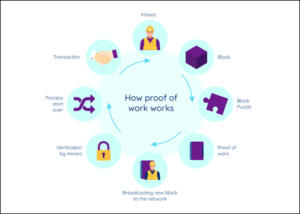
The easiest way to understand how proof of work works is to follow the flow of a new block.
- Users broadcast transactions to the network.
- Miners collect those transactions into a candidate block.
- The miner builds a block header, which includes data such as the previous block hash and a nonce.
- Mining hardware hashes that header over and over.
- If the resulting hash is below the target threshold, the block is valid and can be broadcast to the network.
- Other nodes verify the result quickly and add the block to their copy of the chain.
This works because cryptographic hash functions behave like one way mathematical filters. Change even one small part of the input and the output changes completely. NIST describes hash algorithms as producing a fixed length digest from data of arbitrary length, which is exactly why they are useful here. The miner cannot guess the answer neatly. It has to keep trying.
A simple proof of work example
Here is a stripped down proof of work example. Imagine a blockchain says this:
- Take the block data
- Add a number called a nonce
- Hash everything
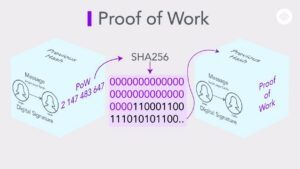
- The resulting hash must begin with four zeroes
A miner starts with nonce 1 and hashes the block. No luck. Then nonce 2. Still no good.
Then nonce 3, 4, 5, 6 and so on. Most results fail. Eventually, perhaps at nonce 48,391, the miner gets a hash that starts with the required zeroes. That is the winning proof.
Now think about what just happened. The miner did not solve the puzzle through insight. It solved it through computation. That is why the system is called proof of work. The valid hash proves that real work was done.
Here is the key security benefit. If someone changes even one transaction in that block, the hash changes. The old proof becomes useless. The attacker must redo the work, then redo the work for every block after it, and then somehow catch up with the honest chain that is still moving forward. That is why proof of work in blockchain makes historical records difficult to rewrite. The cost grows with every new block added on top.
Why proof of work secures blockchains
1. It makes attacks expensive
On a PoW blockchain, attacking the chain requires hardware, electricity and time. An attacker cannot simply create fake authority out of thin air. They need to outwork the honest network.
This is one of the smartest design choices in crypto. Trust is not based on identity. It is based on cost.
2. It protects block history
Every block points to the previous one. That means blocks are chained together. If you alter an old block, you break the link to the next block and must recalculate the proof for the altered block and every block that follows. Bitcoin’s developer documentation is very clear on this point: the cost of changing a block rises as more blocks are added after it.
3. It helps the network choose one canonical chain
In proof of work, nodes generally follow the chain with the most accumulated work. That rule helps thousands of independent participants converge on one shared ledger instead of splitting into endless versions. Nakamoto described this as the longest chain representing the greatest proof of work effort invested.
4. It discourages double spending
Without a mechanism like proof of work, a bad actor could try to spend the same coins twice by rewriting recent history. A strong PoW system makes that increasingly impractical as confirmations build up. This is one reason Bitcoin has kept its reputation as the benchmark proof of work network for settlement security over the years.
Proof of work example with Bitcoin
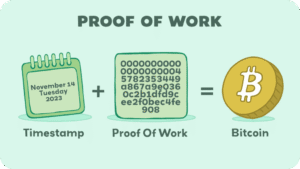
If you want a real world proof of work example, Bitcoin is still the clearest one. Bitcoin miners assemble transactions into a block and hash the 80 byte block header repeatedly until they find a result below the network’s target. If they fail, they keep changing values, including the nonce and other block data, until they eventually get a valid result. The network then verifies that result quickly.
That sounds simple on paper. In reality, it is backed by industrial scale competition. Dedicated ASIC miners perform vast numbers of hashes precisely because the network difficulty is high. And that is the point. A secure PoW blockchain should not be easy to dominate.
From a writer’s point of view, this is where proof of work becomes more than theory. You are not looking at a random puzzle. You are looking at an economic wall around the ledger.
Proof of work in blockchain versus proof of stake

It helps to place proof of work in blockchain in context. Proof of work relies on computation. Proof of stake relies on locked capital. Both aim to achieve consensus, but they secure the network in different ways.
Proof of work is often seen as battle tested. Bitcoin has used it from day one. Ethereum also began with PoW before moving to proof of stake in 2022, and Ethereum’s own documentation now labels PoW there as deprecated.
| Proof of Work | Proof of Stake |
| Validation is done by a network of miners | Validation is done by participants who offer ether as collateral |
| Bitcoin is paid as a reward and for transaction fees | Ether is paid for transaction fees only |
| Competitive nature uses a lot of energy and computational power | Less computational power and energy used |
| Consensus is reached faster because there is no difficulty |
In our experience, beginners often understand proof of work faster because the trade off is tangible. You can picture machines competing, electricity being consumed and blocks becoming harder to fake. Proof of stake is elegant too, but proof of work remains the easiest place to learn how blockchain security is built.
Strengths of proof of work
Proven security
It has protected major networks for years in hostile, open environments. That matters more than theory alone.
Simple verification
Finding a valid block is hard. Verifying it is easy. That asymmetry is one of the strongest parts of the model.
Strong link between cost and security
A network with high total hash power is expensive to attack. That makes PoW especially attractive for high value settlement layers.
Open participation
In principle, anyone can join as a miner, even if in practice industrial mining has raised the bar considerably.
Weaknesses of proof of work
Energy use
This is the criticism most people know. Proof of work consumes significant energy because the security comes from continuous computation. Ethereum’s documentation highlighted this issue before its move away from PoW.
Hardware arms race
Mining has become specialised. In many networks, efficient mining now means professional hardware rather than a laptop in a bedroom.
Potential centralisation pressure
Large mining pools can accumulate influence. The network still has defences, but this is a real operational concern, not a theoretical footnote.
Common mistakes people make when learning proof of work
After years of writing about crypto, we keep seeing the same misconceptions.
- Mistake 1: Thinking miners “create trust”. Not exactly. They create costly proof. The network then verifies it.
- Mistake 2: Thinking the puzzle has a clever shortcut. It does not. That is why proof of work works. If there were a shortcut, the whole model would weaken.
- Mistake 3: Thinking all blockchains still use PoW. They do not. Bitcoin does. Some others do. Ethereum no longer does.
- Mistake 4: Ignoring economics. A secure proof of work network is not just maths. It is maths plus incentives plus real world cost.
Final thoughts
Proof of work is a mechanism that turns computation into security. Miners spend resources to produce a valid block. The network checks that work quickly. Because rewriting history requires redoing that work at scale, honest participation becomes the cheaper path and fraud becomes the expensive one.
That is why proof of work still matters. It is not only about mining. It is about making blockchain integrity costly to break.
If you need one line to remember, use this: proof of work secures blockchains by forcing anyone who wants to change the ledger to outspend and outcompute the honest network.
FAQ
Can you give a simple proof of work example?
Yes. A miner keeps changing a nonce and hashing block data until the hash meets the required target, such as starting with a certain number of zeroes. That valid hash is the proof.
Why is proof of work secure?
It is secure because attacking the chain requires real computational resources, and changing past blocks means redoing the work for that block and all following blocks.
Is Bitcoin a proof of work blockchain?
Yes. Bitcoin is the most famous example of a proof of work blockchain and remains the standard example when explaining how PoW secures a decentralised ledger.
Does Ethereum still use proof of work?
No. Ethereum used proof of work in the past, but it switched to proof of stake in 2022.
Is PoW the same as mining?
Not exactly. PoW is the consensus mechanism. Mining is the process miners perform to satisfy that mechanism and produce valid blocks.
Disclaimer: The material in this article is not financial or investment advice. Everything stated here reflects the author's personal view and should not be treated as a recommendation to trade or invest. We make no warranties regarding the accuracy, reliability or completeness of the information presented. Cryptocurrency markets are highly volatile and can move unpredictably. Before committing any funds, every investor, trader or crypto user should study several independent sources and check the regulations that apply in their own jurisdiction.