
If you spend time in digital asset markets, you will quickly come across the term DEX. For beginners, it can sound technical or even intimidating. In reality, the basic idea is fairly simple. A DEX is a way to swap one crypto asset for another without handing control of your funds to a central company. That is why so many people ask, what is a DEX in crypto, and why the idea has become so important in modern blockchain finance. A DEX, or decentralised exchange, is generally a blockchain based application that lets users exchange digital assets through smart contracts rather than a traditional intermediary.
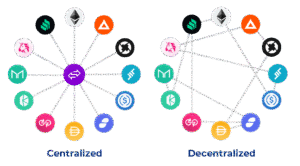
To understand what is a DEX in crypto, it helps to compare it with a standard centralised trading platform. On a centralised exchange, users usually deposit funds into accounts controlled by the platform. On a DEX, users typically trade from their own wallets in a non custodial way, meaning they retain control of their private keys while interacting with the exchange protocol. This is one reason the term decentralized crypto exchange appears so often in educational content around DeFi and on-chain trading.
What is a DEX in crypto?
So, what is a DEX in crypto in plain language? It is a crypto trading system built on blockchain infrastructure that allows people to exchange tokens directly through smart contracts. Instead of relying on a company to hold user funds, process internal balances, and match trades behind closed systems, a DEX settles activity on-chain. That makes the process more transparent, because the smart contracts and transaction history can be inspected on the blockchain.
This leads directly to another common search query, what is a decentralized exchange. A decentralised exchange is simply an exchange where trading is facilitated by code and blockchain settlement rather than by a central operator controlling custody and execution. In other words, what is a decentralized crypto exchange? It is a trading venue where users connect wallets, approve transactions, and swap blockchain based assets through decentralised protocols.
Why DEXs became so important
The rise of the decentralized crypto exchange model is tied closely to the growth of decentralised finance, often called DeFi. DeFi refers to an ecosystem of permissionless and transparent financial services built on blockchains. Within that ecosystem, DEXs have become one of the most visible and widely used tools because they let users trade without depending on a bank, broker, or exchange operator in the traditional sense.
For many users, the appeal of decentralized crypto trading comes down to control. They want to keep custody of their assets, interact directly with protocols, and access markets that may not be listed on conventional exchanges. Others are attracted by transparency, because on-chain systems make it easier to inspect liquidity, transaction history, and the logic behind execution. That does not mean DEXs are always better in every situation, but it does explain why DEX crypto has become such a major part of the industry.
How a DEX works
To understand DEX crypto meaning, it is useful to look at the mechanics. A user usually begins by connecting a self custodial wallet to a DEX interface. The wallet can then interact with the relevant smart contracts. If the user wants to swap Token A for Token B, the smart contract checks the available liquidity, calculates a price, and executes the swap on-chain once the transaction is confirmed. This is different from the account based model used by most centralised exchanges.
Many well known DEX platforms use an automated market maker model, often called an AMM. In an AMM system, users do not necessarily trade against a live order book in the traditional sense. Instead, they trade against liquidity held in smart contract based pools. These pools are funded by liquidity providers, who deposit token pairs into the protocol and may earn a share of trading fees in return.
DEX trading and liquidity pools
Because AMMs are so common, DEX trading is often closely connected to liquidity pools. A liquidity pool is a shared pool of assets that traders can swap against. If there is deep liquidity, trades can often be executed more smoothly. If liquidity is thin, slippage can become a problem, meaning the actual execution price may move away from the quoted price. Liquidity is therefore central to how any crypto DEX performs in practice.
Liquidity providers are another key part of the ecosystem. These users contribute funds to pools and help make DEX exchange activity possible. In return, they may receive fees generated by trades, although providing liquidity also comes with risks, including impermanent loss.
Types of DEX platforms
Not all DEX platforms work in exactly the same way. Some rely mainly on AMMs and liquidity pools. Others use on-chain or hybrid order book systems. Some DEXs focus on spot swaps, while others specialise in more advanced products such as perpetuals or leveraged trading. Ethereum.org notes that decentralised trading can extend beyond simple swaps to include more advanced trading tools, though these are often more complex.
There are also DEX aggregators, which are protocols designed to search across multiple sources of on-chain liquidity in order to find better execution routes. Instead of trading against one specific pool, an aggregator may route a trade across several venues.
Main advantages of a decentralized crypto exchange
One major advantage of a decentralized crypto exchange is self custody. Users do not always need to transfer assets into an exchange owned wallet before trading. This reduces dependence on a central platform holding customer funds. Another advantage is transparency, since pricing logic, pool balances, and transactions can often be reviewed on-chain or through public documentation. Accessibility is also important, as blockchain based systems can be open to anyone with a compatible wallet and internet access, subject to regional or protocol constraints.
For many traders, decentralized crypto markets also create access to a wider range of tokens. New assets may appear on-chain before they are listed on larger centralised venues. That can create opportunity, although it can also increase risk. This is why learning what is a DEX in crypto should always go hand in hand with understanding wallet safety and token verification.
Risks and drawbacks of DEX crypto
Although the benefits are real, DEX crypto is not risk free. Smart contract vulnerabilities are one important concern. Because a DEX relies on code, any bug or exploit in that code can create losses. Another issue is slippage, especially in smaller pools or volatile markets. Gas fees can also be significant on some networks, making smaller trades less efficient.
There are also risks related to transaction ordering and MEV, or maximal extractable value. Ethereum.org explains MEV as value extracted by changing or controlling transaction order within a block. In practice, this can affect on-chain traders through sandwiching or other adverse execution outcomes. That means DEX trading may expose users to forms of market friction that feel different from those on centralised venues.
Finally, user responsibility is much higher. On a decentralized crypto exchange, there is usually no customer support team that can reverse an incorrect wallet address or recover a lost seed phrase. If you connect your wallet to a malicious application or approve a harmful transaction, the consequences can be immediate. That is a core part of DEX crypto meaning in real life: more freedom, but also more responsibility.
DEX exchange versus centralised exchange
A useful way to answer what is a decentralized exchange is to compare it directly with a centralised exchange. A centralised platform usually manages custody, user accounts, internal order matching, and platform level security controls. This can feel convenient, especially for newcomers. A DEX exchange, by contrast, typically relies on wallet based access, smart contracts, and on-chain execution.
Centralised exchanges may offer easier onboarding, fiat support, and customer service. DEXs may offer stronger self custody, transparency, and broader access to on-chain assets. Neither model is perfect for every person or every situation. Many experienced users actually use both, depending on whether they prioritise convenience, liquidity, speed, or control.
What is a decentralized crypto exchange used for?
A decentralized crypto exchange can be used for simple token swaps, portfolio rebalancing, yield strategies, arbitrage, and access to emerging on-chain markets. Some users use a crypto DEX simply to swap major tokens. Others use DEX platforms to interact with the wider DeFi ecosystem, where tokens can move between lending protocols, liquidity pools, staking systems, and derivatives applications.
This wider role helps explain why the question of what is a DEX in crypto matters so much. A DEX is not just another website for swapping tokens. In many cases, it functions as a gateway into decentralised finance as a whole.
Is DEX trading suitable for beginners?
Beginners can certainly learn DEX trading, but they should approach it carefully. It is essential to understand wallet security, gas fees, token approvals, slippage, and the difference between official and fake interfaces. Small test transactions are often wise. So is sticking to better known protocols and double checking contract addresses.
In other words, if you are asking what is a DEX in crypto, the answer should include both opportunity and caution. A DEX can offer more control than a centralised platform, but it also expects users to take more responsibility for execution, security, and decision making.
Final thoughts
So, what is a DEX in crypto? It is a decentralised exchange that allows users to trade digital assets through blockchain based smart contracts rather than through a traditional intermediary. A decentralized crypto exchange gives users direct, non custodial access to on-chain markets and has become a core part of the DeFi ecosystem.
Understanding what is a decentralized crypto exchange means understanding both the promise and the trade offs. DEXs can offer self custody, transparency, and broad market access. At the same time, they can expose traders to smart contract risk, slippage, gas costs, and MEV related execution issues. For some users, that balance is well worth it. For others, a hybrid approach using both centralised and decentralised services may make more sense.
As decentralized crypto continues to evolve, DEXs are likely to remain one of its most important building blocks. Whether you are researching DEX crypto, comparing DEX platforms, the key idea is straightforward: a DEX lets you trade on-chain while keeping more direct control over your assets.
FAQ
What is a DEX in crypto?
A DEX is a decentralised exchange that lets users trade crypto assets through blockchain based smart contracts without relying on a central custodian.
How do dex platforms get liquidity?
Many dex platforms rely on liquidity pools funded by liquidity providers. These pools allow traders to swap assets, and providers may earn fees in return.
What is dex crypto meaning for beginners?
For beginners, dex crypto meaning usually refers to on-chain, wallet based crypto trading without handing over custody to a central exchange. It offers more control, but also more responsibility.
Is dex trading safer than using a centralised exchange?
It depends on what kind of risk you mean. DEXs reduce custodial risk because users keep control of funds, but they introduce other risks such as smart contract bugs, slippage, wallet mistakes, and MEV related execution issues.
What is the difference between a crypto dex and a centralised exchange?
A crypto dex generally uses wallets, smart contracts, and on-chain settlement, while a centralised exchange usually controls custody, accounts, and internal matching systems.